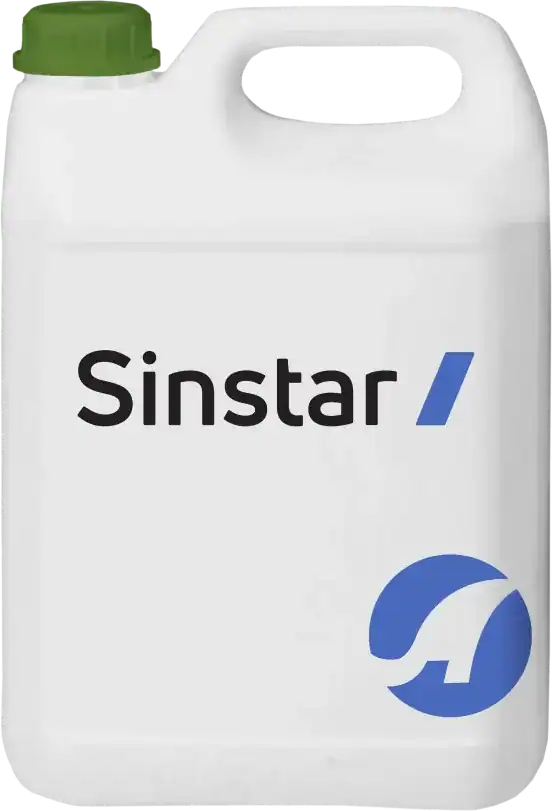
SINSTAR® is a broad spectrum fungicide formulated as a Concentrated Suspension (SC) based on azoxystrobin 25% w/v (250 g/L), authorized for use on wheat, barley, grapevine and tomato.
It acts as a systemic fungicide with translaminar activity, with preventive and curative effect, and presents slow acropetal translocation with uniform distribution on the leaf.
Authorized crops
Wheat, barley, grapevine and tomato.
Controlled diseases (according to crop)
Barley: reticular helminthosporiosis(Pyrenophora teres), powdery mildew (Blumeria graminis), rhynchosporiosis/scald(Rhynchosporium secalis) and brown or dwarf rust(Puccinia hordei).
Wheat: alternaria(Alternaria triticina), stripe rust (Puccinia striiformis), brown rust(Puccinia triticina) and septoria(Zymoseptoria tritici).
Very toxic to aquatic organisms, with long lasting harmful effects. Do not contaminate water with the product or its container.
Respect the safety strips: 5 m in vineyards and 10 m with vegetation cover in cereals and tomatoes up to surface water bodies.
Avoid drift, runoff and release to the environment.
In application and handling of the equipment, use the protective equipment indicated on the label.
Do not enter treated crops until the spray has dried.
Packaging management
Rinse each container vigorously three times, incorporating the rinse water into the spray tank, and deliver the empty container to the authorized collection points.
Preventive and curative against foliar diseases in cereals, grapevine and tomato.
Available formats:
Broad spectrum fungicide with azoxystrobin 250 g/L for wheat, barley, grapevine and tomato.
Preventive and curative action with systemic and translaminar effect for a more uniform foliar control.
APPLY IN THE FOLLOWING PHASES
Vegetative growth (leaf mass / vigor)
Pre-flowering (visible bud / bunch)
Flowering
Curdling
Fruit development (fattening)
Wrapping / color change (if applicable)
Maturation
Pre-harvest (last deficiency treatments)
Cultivo
Plaga o enfermedad
Dosis de aplicación L/HA
Nº aplicaciones
Período de cadencia
Período de reentrada
Plazo de seguridad (días)
Cebada
Helmintosporiosis reticular de la cebada, Pyrenophora teres Oídio de los cereales, Blumeria graminis Rincosporiosis, escaldado de cereales, Rhynchosporium secalis Roya parda o enana de la cebada, Puccinia horde
1
2
14
35
Tomate
Alternaria de las solanáceas, Alternaria solani Cladosporiosis del tomate, Fulvia fulva Mildiu de la patata y el tomate, Phytophthora infestans Oídio del tomate, Oidium neolycopersici
0,8
2
7
3
Trigo
Alternariosis del trigo, Alternaria triticina Roya amarilla del trigo, Puccinia striiformis Roya parda del trigo, Puccinia triticina Septoriosis del trigo, Zymoseptoria tritici
1
2
14
35
Vid
Mildiu de la vid, Plasmopara viticola Oídio de la vid, Erysiphe necator
1
2
10
21
SINSTAR®.
Download the complete catalog and safety data sheet for SINSTAR®..
Las cookies de estadísticas recopilan información de forma anónima. Esta información nos ayuda a comprender cómo utilizan nuestro sitio web los visitantes.
Nombre
Descripción
Duración
_ga_7MMQ6QYGF1
Se utilizan para distinguir usuarios y recopilar datos estadísticos anónimos sobre la navegación en el sitio web.
2 años
Servicio de analítica web que permite medir el uso del sitio y obtener estadísticas agregadas y anónimas sobre la navegación.