


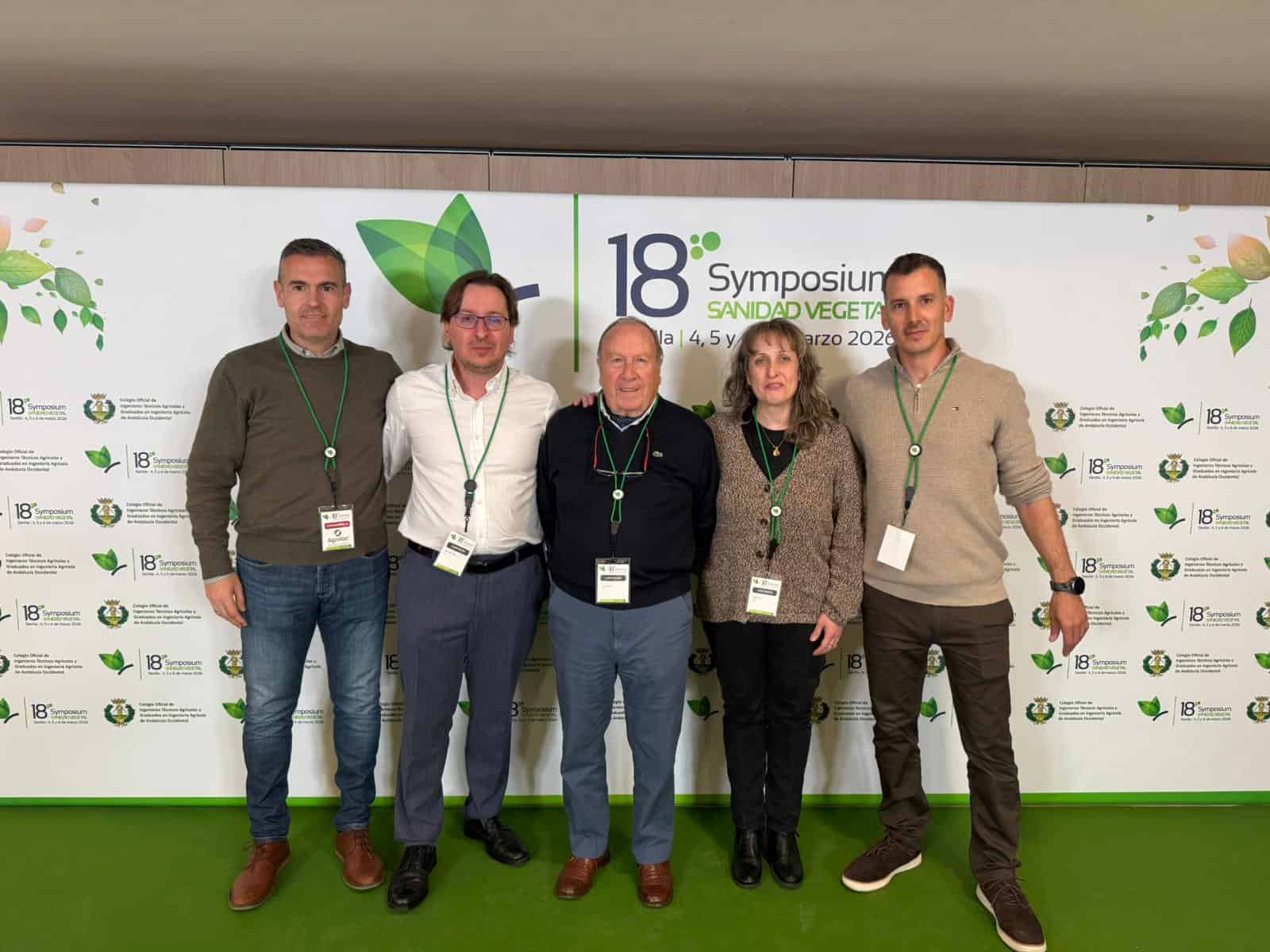
AGROLAC’s participation in the 18th Seville Plant Health Symposium was a particularly positive experience for the company. The conference aroused interest among attendees, generated valuable conversations at the end of the session and allowed to convey a clear message: useful agricultural innovation is not only born in large multinational groups, but also in medium-sized companies that decide to take risk, invest in the long term and work with scientific rigor. The very structure of the presentation was designed to demonstrate this, combining a technical part given by Dr. Emilio Montesinos, from the University of Girona, with a second part focused on AGROLARIX, presented by Miguel Sarrión.
But to understand the meaning of this conference, it is important to start at the beginning: why AGROLAC decided to invest in R&D and why this investment has become one of the most important pillars of its current identity.
The origin of the commitment to R&D: a strategic transformation, not a defensive reaction
AGROLAC was born as a distributor of active ingredients for companies in the agrochemical sector and for decades occupied a recognized position in the Spanish phytosanitary market. Its activity was supported by a solid portfolio of registrations and agreements with international manufacturers. However, the progressive tightening of European regulations on traditional chemical products forced many companies in the sector to redefine their path. In this context, AGROLAC made a strategic decision that today is proving to be decisive: not to limit itself to reducing activity or resigning itself to an increasingly narrow role, but to pivot towards a new model based on its own innovation, sustainability, scientific validation and internationalization.
This pivot was neither a simple commercial change nor a cosmetic adjustment of the catalog. It was a profound redefinition of the company’s role in the value chain. In Europe, the focus was on the development of proprietary biological solutions through the AG LifeSolutions R&D program. At the same time, in Latin America, Agrolac Andina Colombia and Agrolac Andina Peru were created, with local structures capable of operating in markets where traditional chemical products were still in demand, while at the same time opening the door to the introduction of biological innovations developed by the company.
This development explains very well the background of the conference held in Seville. What was presented there was not just a product or a corporate success story. What was shown was the result of a business transformation guided by a very specific conviction: when the regulatory environment changes and agriculture changes, a company can choose to shrink or it can decide to develop its own technology. AGROLAC chose the latter.
A new phase based on efficiency, responsibility and global vision
AGROLAC’s new phase is based on three central ideas. The first is efficacy, understood not as a commercial promise, but as the result of rigorous testing, successive validations and formulations designed to offer a real effect in the field. The second is responsibility, because sustainability, safety and impact reduction are no longer a reputational add-on, but a requirement of modern agriculture. And the third is global vision, with a structure prepared to grow both in Europe and Latin America.
This was precisely the context that gave meaning to the Symposium conference. The conference did not limit itself to talking about innovation as an abstract concept, but tried to explain how this innovation is really built: with years of work, scientific alliances, trials, errors, validations, reformulations and a constant will to convert knowledge into applicable solutions.
We put forward a double proposal: on the one hand, a technical presentation on the development of biological solutions for plant protection and nutrition based on native microorganisms; on the other hand, a corporate and technological presentation aimed at showing how innovation based on biotechnology can be translated into real, scalable solutions aligned with the current demands of sustainability, productivity and safety.
A conference divided into two halves, united by a single idea
The first half revolved around the R&D projects developed by the company over more than a decade together with different universities and research centers, with special emphasis on the University of Girona. This part was given by Dr. Emilio Montesinos, and had a strong scientific and methodological weight. It explained the path followed by AGROLAC and VICORQUIMIA in the development of sustainable solutions for plant health, with special attention to the use of native microorganisms selected through a rigorous research process. The summary presented for the Symposium highlighted that this collaboration is an example of technology transfer with concrete results and scientific validation.
The second half focused on AGROLARIX, one of the company’s most representative developments, and was presented by Miguel Sarrión. This part approached the product not only from its commercial fit, but also from its technical basis, its development process and its place within a more productive, sustainable and healthy agriculture. The presentation itself defines AGROLARIX as a new generation development regulator biostimulant, formulated as an encapsulated soluble liquid based on dihydroquercetin from Siberian larch.
Although both halves had different tones, the common thread was the same from beginning to end: how knowledge generated in the university can flow into the company when there is a real, sustained and results-oriented collaboration, and how this collaboration can materialize in concrete technologies developed from within an SME.
The first half: more than a decade of R&D and university collaborations
Dr. Emilio Montesinos’ speech focused on an essential issue: serious agricultural innovation is not born of improvisation. It requires method, time, clear objectives and the capacity to sustain the investment for years. According to the documentation presented, this line of work is based on a commitment to a more sustainable, efficient and environmentally friendly agriculture. The initial exploratory work was also explained, which included the collection of more than 100 weed species over two years, with root and soil samples taken for microbiological analysis, which made it possible to identify strains with high bioactive potential.
The presentation also addressed the methodologies used in the selection, isolation and evaluation of beneficial microorganisms, as well as the technologies applied in the formulation of products that ensure stability, efficacy and ease of use. Highlights included the identification of target pests and diseases, the study of the modes of action of the selected microorganisms and the resolution of technical formulation problems, something that is often hidden in commercial discourse, but is in fact a central part of technological development.
These university partnerships have enabled the development of science-based products for the control of pests, diseases, abiotic stress and quality improvement.
This point was particularly important at the conference because it dismantles an idea that is still too widespread: that SMEs should limit themselves to distributing technologies developed by others. AGROLAC wanted to defend something much more ambitious. A small or medium-sized company can also generate applied knowledge, build technological property, validate products and raise its own competitive barriers. It is more difficult, requires more patience and involves more risk, but precisely for that reason the value created is also greater.
The second half: AGROLARIX as a tangible example of this philosophy
If the first part explained the framework, the second part showed a concrete test. AGROLARIX did not appear at the conference as a simple commercial launch, but as the visible result of a way of working.
The product presentation describes AGROLARIX as a new generation plant growth and development regulator biostimulant, nanoencapsulated using cyclodextrins, a technology aimed at solving historical limitations of dihydroquercetin, such as instability and low bioavailability. Among the advantages reported are its stability against light, temperature and oxidation, its aqueous solubility, its penetration into plant tissues, the possibility of foliar application or via irrigation and its efficacy at low dosage.
The chronology of AGROLARIX development is also significant. The presentation captures a working sequence of more than a decade: initial trials between 2014 and 2016 in crops such as tomato, zucchini, lettuce, citrus, corn and ornamentals; scale-up and confirmation in new crops between 2017 and 2021, with more than 50 field trials accumulated; university research between 2020 and 2024 on plant metabolism and nanoencapsulated formulation; and finally the registration and commercialization stage between 2023 and 2026.
Beyond the chronology, the interest of the AGROLARIX case lies in the fact that it embodies very well the type of innovation that the company wanted to defend in Seville. It is not just a matter of having an interesting molecule or raw material, but of transforming it into a usable, stable, effective, validated and economically defensible agronomic tool.
The technical presentation itself includes relevant scientific results on physiology and production. Among them, improvements in leaf and root water status, increased chlorophyll content and photosynthetic activity at flowering, more efficient mobilization of carbohydrates to fruit, hormonal modulation and increased total number of fruits, maintaining and improving in some crops the quality parameters equivalent to the control.
That approach fit perfectly with the overall objective of the conference: to show that innovation is not just about “having something new,” but about building solutions that respond to real crop and farmer needs.
Knowledge transfer: from the university to the field
One of the strongest messages of the day was the value of knowledge transfer. Too often we talk about university and business as if they were parallel worlds, with irreconcilable rhythms, interests and languages. However, the experience presented by AGROLAC and the University of Girona shows that this separation is not inevitable.
When there is a well-oriented collaboration, the university contributes scientific depth, methodology, analytical capacity and experimental rigor. The company, on the other hand, brings practical vision, market knowledge, identification of real needs, formulation capacity, field validation and willingness to take the technology to the end user. The combination of both worlds accelerates the arrival of useful solutions for agriculture.
This was one of the most valuable points of the conference. It was not just a matter of claiming research as an abstract value, but of showing a concrete case in which this research has been progressing towards real applications. The documentation presented underlines precisely this desire to provide a practical vision of how innovation based on biotechnology can offer scalable solutions that are aligned with the reality of the sector.
Innovation as a barrier, a differential value and a courageous business decision
Another of the main underlying messages was that innovation implies risk, which is precisely why it also implies opportunity. Committing to R&D requires resources, patience and endurance. Not all projects prosper at the same rate, not all research leads to profitable products and not all developments find an immediate market fit. But giving up on innovation also has a cost: technological dependence, less differentiation and much greater exposure to competing on price alone.
AGROLAC wanted to convey that innovation should not be seen only as a cost or as an uncertain adventure, but as a great barrier to entry and as a way to build real value for the company and for the industry. A company that develops its own technology not only expands its portfolio; it strengthens its positioning, improves its negotiating capacity, generates high-value intangible assets and is in a much stronger position to face regulatory, technical or competitive changes.
This message is particularly relevant in the case of small and medium-sized companies. For years, many SMEs in the sector have assumed that their role should be limited to buying, distributing or adapting technology created by others. The conference advocated the opposite idea: a well-managed SME, with a strategic vision and the right scientific alliances, can also research, formulate, validate and launch its own developments. And when it does so, it raises not only its own level, but also that of the industrial ecosystem as a whole.
A very positive reception in Seville
The good reception of the conference confirmed that this approach connects with a real need in the industry. Attendees showed interest in the content, the structure of the presentation and the balance between science, business vision and practical application. It was neither a purely institutional talk nor a closed presentation on a single product. It was a broader proposal: a reflection, supported by facts, on how agricultural innovation must be built if it is to be useful and long-lasting.
For AGROLAC, this interest is of particular value because it confirms that the path taken years ago makes sense. The transformation that began after the fall of certain registers was not a retreat, but a reinvention. And that reinvention can now be explained with facts: collaborations with universities, trials, proprietary products, international expansion and a business narrative that is consistent with the current state of the sector.
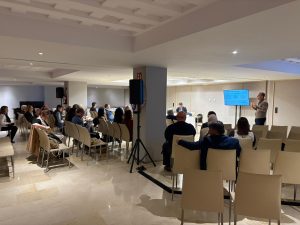
Thank you for joining us!
Participation in the 18th Seville Plant Health Symposium was, in short, an excellent opportunity to share a vision of a company based on knowledge, technology transfer and innovation with purpose. The conference allowed to explain where AGROLAC comes from, why it decided to bet on R&D, how it has worked for more than a decade with universities and research centers, and how this trajectory is already translated into concrete developments such as AGROLARIX.
From AGROLAC we would like to sincerely thank the attention, the interest shown and the welcome received during the day. We left Seville with the satisfaction of having shared a real story of transformation and with the reinforced conviction that the agriculture of the future will need more science, more collaboration and more companies willing to develop their own technology.
But it also creates barriers, generates value, strengthens companies and brings solidity to the entire industry.